
This summer, rediscover standout stories from our archives.
We asked 14 ISU Senior teams from Canada to Italy whether they could think of any interesting expressions in either their national or team-specific skating language. A lot of skating lingo originates from North America and is similar throughout the whole ice skating world, synchronized skating included. But as the discipline evolves, so does the difficulty and variety of its tricks and turns, and new jargon is needed.
The similarity of expressions was present in some of the responses we got. “I think most of the elements and movements are the same [as] in English,” said our responder from the Finnish Helsinki Rockettes. When asked, Icicles Seniors from Great Britain emphasized that they lack interesting examples because their native tongue is English: “…I guess that a ‘mohawk’ is funny because it is a hairstyle, and of course, a ‘death spiral’ sounds a lot worse than it is.”
These expressions are used throughout all skating disciplines. In addition to steps and common pair tricks, synchronized skaters also need terms for different elements. Some of those are named similarly, even when the term is in the team’s own local language—for example, many languages call the wheel element something similar to a windmill. In Czech, it is ‘vetrník’, as told by team Olympia from Prague.
These expressions are used throughout all skating disciplines. In addition to steps and common pair tricks, synchronized skaters also need terms for different elements. Some of those are named similarly, even when the term is in the team’s own local language—for example, many languages call the wheel element something similar to a windmill. In Czech, it is ‘vetrník’, as told by team Olympia from Prague.
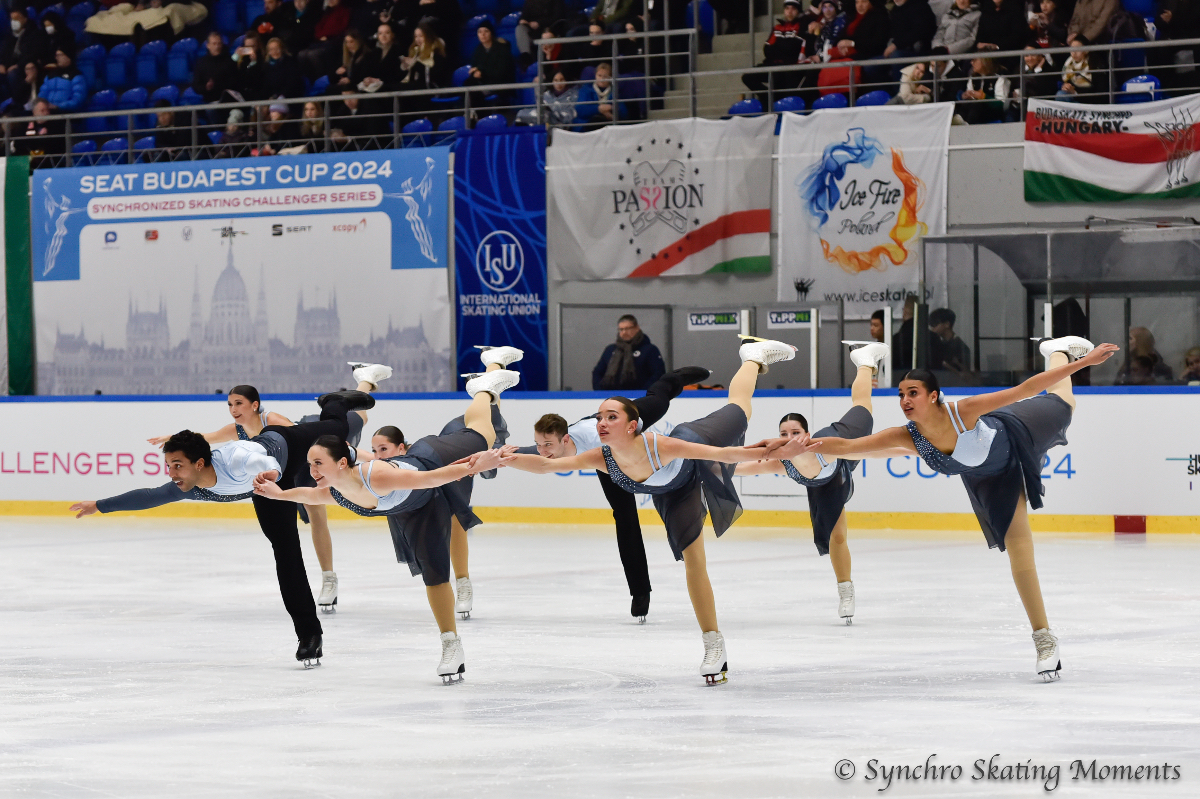 Les Zoulous from France often have to clarify certain words at the start of the season so that everyone understands each other. (Credits: Synchro Skating Moments, Eva Rosta - 2024)
Coaches’ influence
Not always are the expressions standardised even within the same country. Les Zoulous from Lyon, France commented that: “Our team has members from all over France and we find it funny that not everyone in France has the same skating vocabulary or pronunciation. It's always funny at the beginning of the season when we realise that not everyone understands the same words!”
Skaters also move across the country borders and mix skating language – and so do coaches! For example, the Spanish Team Fusion told us that they still use some of the expression left behind by their previous, Swedish coach. Coaches’ influence is also visible in Canada, where Les Suprêmes Senior trains with Marilyn Langlois. “Marilyn likes to add 'ou' to the end of element names; for example, ‘twizzlou’ [or] ‘whipou’.”
Skaters also move across the country borders and mix skating language – and so do coaches! For example, the Spanish Team Fusion told us that they still use some of the expression left behind by their previous, Swedish coach. Coaches’ influence is also visible in Canada, where Les Suprêmes Senior trains with Marilyn Langlois. “Marilyn likes to add 'ou' to the end of element names; for example, ‘twizzlou’ [or] ‘whipou’.”
Sometimes terminology is brought on ice by coaches outside of the discipline. This is the case in Zürich, Switzerland, the homebase of senior team Starlight Elite. “We do a lot of choreography also on the ice with our dance coach. She always uses words instead of counts for the music therefore all of our movements have special names now! Some examples are ‘bamboo’, ‘oompaloompa’ or ‘the chicken’,” they revealed us.
“We always come up with our own names for certain skating movements and exercises we have crafted ourselves,” said Team Inspire from Landvetter, Sweden, highlighting how the need for new terms brings on an opportunity for creativity. “[For example], our creative lift from Worlds 2022 is known as the ‘toast’, a particular skating skills exercise goes by the name ‘hockey’, and one of our on-ice warm-up routines is called ‘Pokémon’. These names definitely add a touch of individuality and humour to our routines.”
“We always come up with our own names for certain skating movements and exercises we have crafted ourselves,” said Team Inspire from Landvetter, Sweden, highlighting how the need for new terms brings on an opportunity for creativity. “[For example], our creative lift from Worlds 2022 is known as the ‘toast’, a particular skating skills exercise goes by the name ‘hockey’, and one of our on-ice warm-up routines is called ‘Pokémon’. These names definitely add a touch of individuality and humour to our routines.”
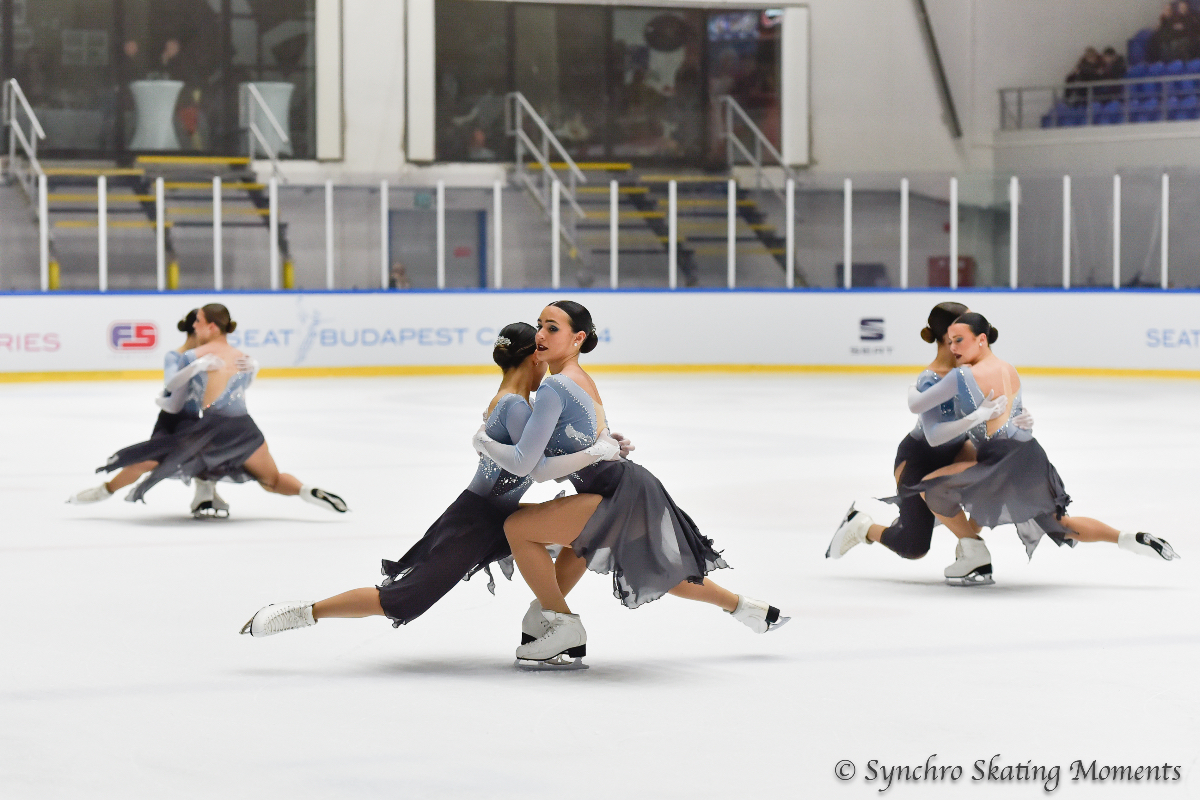 At Les Suprêmes, coach Marilyn Langlois has her own language for naming elements. (Credits: Synchro Skating Moments, Eva Rosta - 2024)
Many other teams also mentioned that they name moves after the theme of their program, particularly for tricks and lifts invented for that season. The variety of language demonstrates how creatively skaters and coaches come up with new moves every year.
Team Unique has an invented name for its traditional hairdo
“We give names for different moves on our programs, e.g., we had a little move in our free program last year and named that ‘the avocado’,” mentioned the German team United Angels. Indeed, multiple skating terms are named after the nature – examples we heard were ‘tulip’, ‘moon’, ‘lizard’, ‘fish’, ‘flying squirrel’, ‘dove’, and ‘bird’s nest’.
And finally, not only skating moves get creatively named. Team Unique from Helsinki, Finland revealed to us that the traditional competition hairdo, a sleek ponytail done with gel, is called ‘liima’ – or ‘glue’ in English.
And finally, not only skating moves get creatively named. Team Unique from Helsinki, Finland revealed to us that the traditional competition hairdo, a sleek ponytail done with gel, is called ‘liima’ – or ‘glue’ in English.