
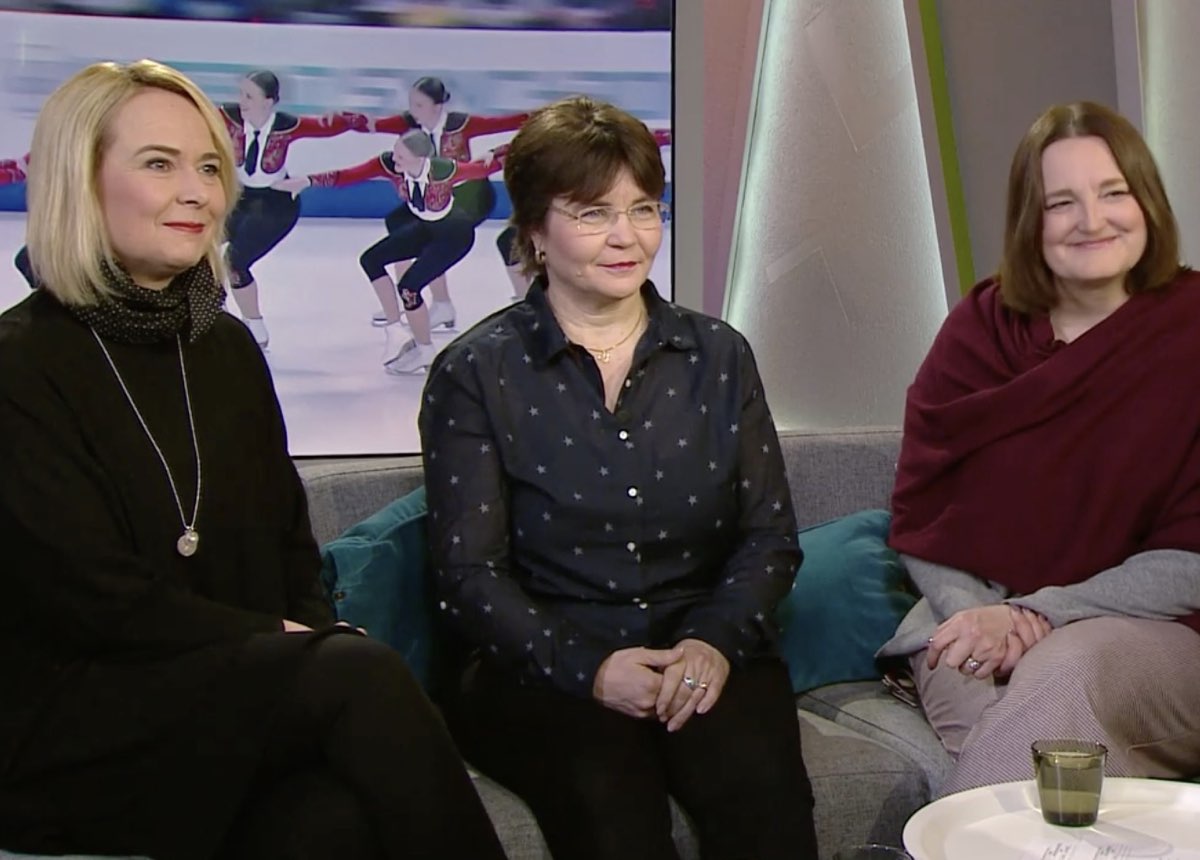
In the beginning, the Finnish journalists ask the coaches what is the most important in Nationals. All agreed that the competition next weekend is going to be hard and interesting. Teams have to turn in and skate technically clean programs. All the teams are in good form and ready for the competition.
rnIsn´t it a good thing to have so many excellent teams in Finland?
rnKaisa Arrateig (Helsinki Rockettes): This situation guarantees a good competitive ability internationally. To achieve the place in Worlds isn´t self-evident to any team. It requires a lot of hard work.
rnSynchronized skating teams have a high interdependence so what happens if some skater makes a mistake?
rnAnu Oksanen (Marigold Ice Unity): It is always a mistake for the whole team not just for the individual and the team gets well used to that kind of situations in the training. The team gets over it and forgets it very quickly. They just keep skating the program and doing their best.
rnMirjami Penttinen (Team Unique): We can assure that after a mistake in a performance, coaches never blame or shout to the skaters. Of course, an error may cost a lot, you even may lose a medal and it is a difficult situation for the team and the coach, but you just have to handle it and get over it, and you certainly will, when time elapses.
How do you create the team spirit?
rnAnu Oksanen (Marigold Ice Unity): When the skaters are together for a long time, the team spirit grows naturally. The athletes have common goals, common dreams and they work hard for that on the ice and after the training every day, week after week.
rnKaisa Arrateig (Helsinki Rockettes): Many of the skaters have been together several years starting from the minors and ending up to the senior level. New skaters from other teams are joining but they all are able to create a firm confidence in each other. The common confidence and the responsibility of the individuals are the most important factors.
rnHow much do your teams practice?
rnMirjami Penttinen (Team Unique): About 25 to 27 hours in a week.
rnAnu Oksanen (Marigold Ice Unity): Yes, that’s correct. We really appreciate the skaters because they practice like professional athletes even if they aren´t. In addition to practicing, they all are either at school, at university or at work.
rnHow expensive is this sport?
rnMirjami Penttinen (Team Unique): It is expensive if you think how much it costs for the families or the skaters. But then again you can think what you get for that money. Skaters have a professional and big coaching team, which helps and guides them and in addition, they learn a lot of valuable things: they have to learn to push themselves forward, meet challenges, learn how to control their feelings and learn how to work in teams.
What about the Olympics 2022?
rnAll the coaches emphasize that synchro should and could be in the Beijing Olympics 2022. The coaches said that the ISU is working hard for that and many Finnish representatives like Kaisa Arrateig have been in China to promote the sport. The main obstacle is obviously economical when there will be so many new athletes in the competition. It is still possible if China interests more of synchro and if they can create their own good synchro teams.
rnMirjami Penttinen thinks sporting in the Olympics would be even more important to some other countries than Finland where synchronized skating is quite well known. “There are a lot of excellent teams around the world which train extremely lot, but they have a minimal visibility in their countries”, she said The coaches promised to bring an Olympic medal for Finland if this Olympic dream comes true.
rnWhat about the Worlds in Stockholm?
rnThe coaches think that to win a medal for Finland in the World Championships is a realistic goal. Especially they want to challenge Russia. Even if the training circumstances in Russia are much better, there are many potential skaters and the skaters in the teams are professional athletes the difference between the scores isn´t out of reach.
rnKaisa Arrateig thinks that the Finnish coaching philosophy and values differ from Russian. In Finland, the Teams are very close units, they are more than the sum of its parts but in Russia, the teams are more like groups of skillful individuals. Mirjami Penttinen also knows that in Russia they don´t use psychological coaching at all. In Finland, it is an important part of practicing.
In addition to the excellent programs and skating, strong teamwork and good mental skills help Finnish teams to achieve their goals, said the coaches. The Finnish national championships will take place Saturday and Sunday in Helsinki.
rnrn