
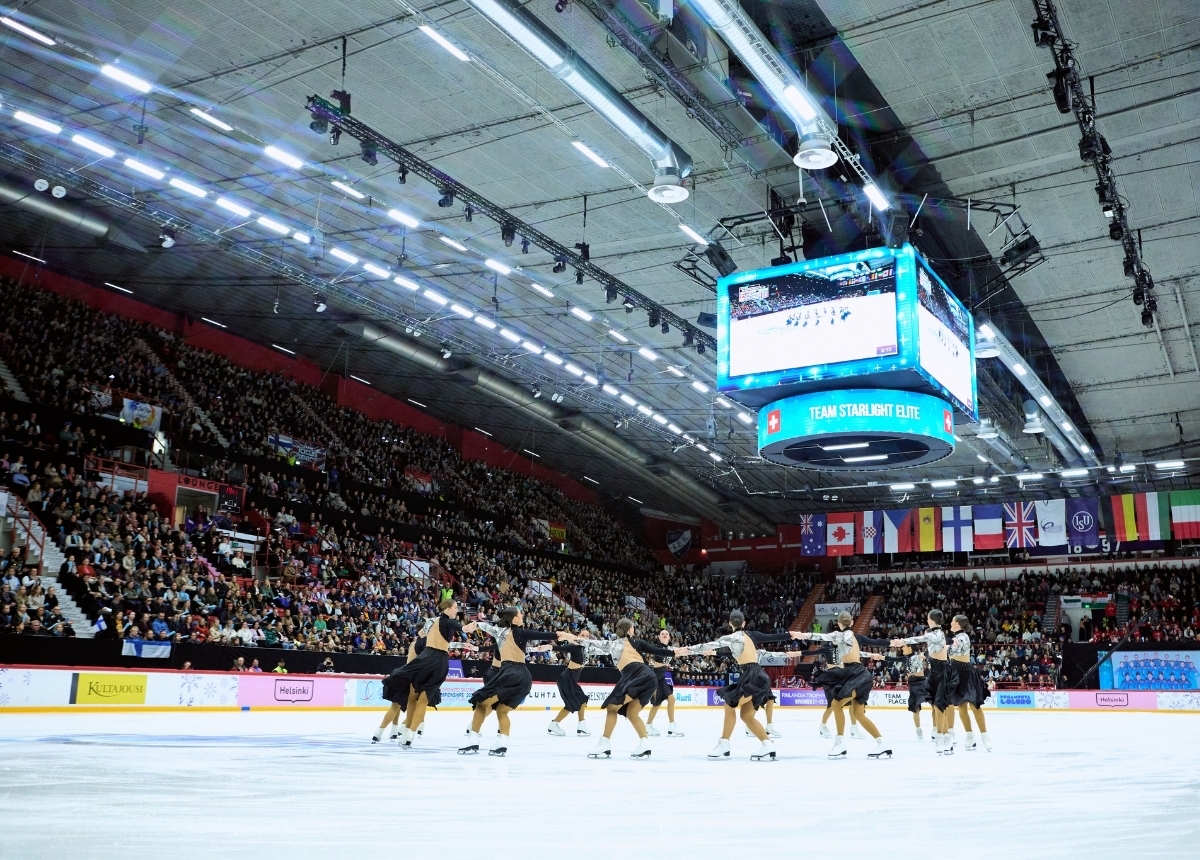
In 2019, 24 teams competed at the Senior World Championships in Helsinki, including an entry from China. In 2022 (Hamilton) and 2023 (Lake Placid), the field stabilized at 23 teams, featuring nations like Belgium, Sweden, and Latvia.
In 2024, 21 teams skated in Zagreb, including Turkey. And most recently, in 2025, Helsinki welcomed 20 teams to the event.
In 2024, 21 teams skated in Zagreb, including Turkey. And most recently, in 2025, Helsinki welcomed 20 teams to the event.
Rising standards, real constraints
This small contraction doesn’t reflect a weakening of the sport—but rather its increasing demands. Today’s synchronized skating teams are composed of highly trained athletes, often committing full seasons to intense preparation. Not all federations have the financial capacity to support teams on the world stage. The long-term impacts of the COVID-19 pandemic also continue to shape participation levels.
Despite the lower numbers, the World Championships remain a showcase for a wide global community. Core nations like Finland, the USA, Canada, Italy, Germany, and Japan continue to lead, while Hungary, the Netherlands, France, and others maintain a regular presence.
Despite the lower numbers, the World Championships remain a showcase for a wide global community. Core nations like Finland, the USA, Canada, Italy, Germany, and Japan continue to lead, while Hungary, the Netherlands, France, and others maintain a regular presence.
Looking ahead, several countries could make a comeback. Mexico, for instance, competed at past Senior Worlds. In Asia, efforts are ongoing to grow synchronized skating—initiatives that could yield results in the coming seasons.
As the sport continues to professionalize, its global reach may evolve, not disappear.
As the sport continues to professionalize, its global reach may evolve, not disappear.