
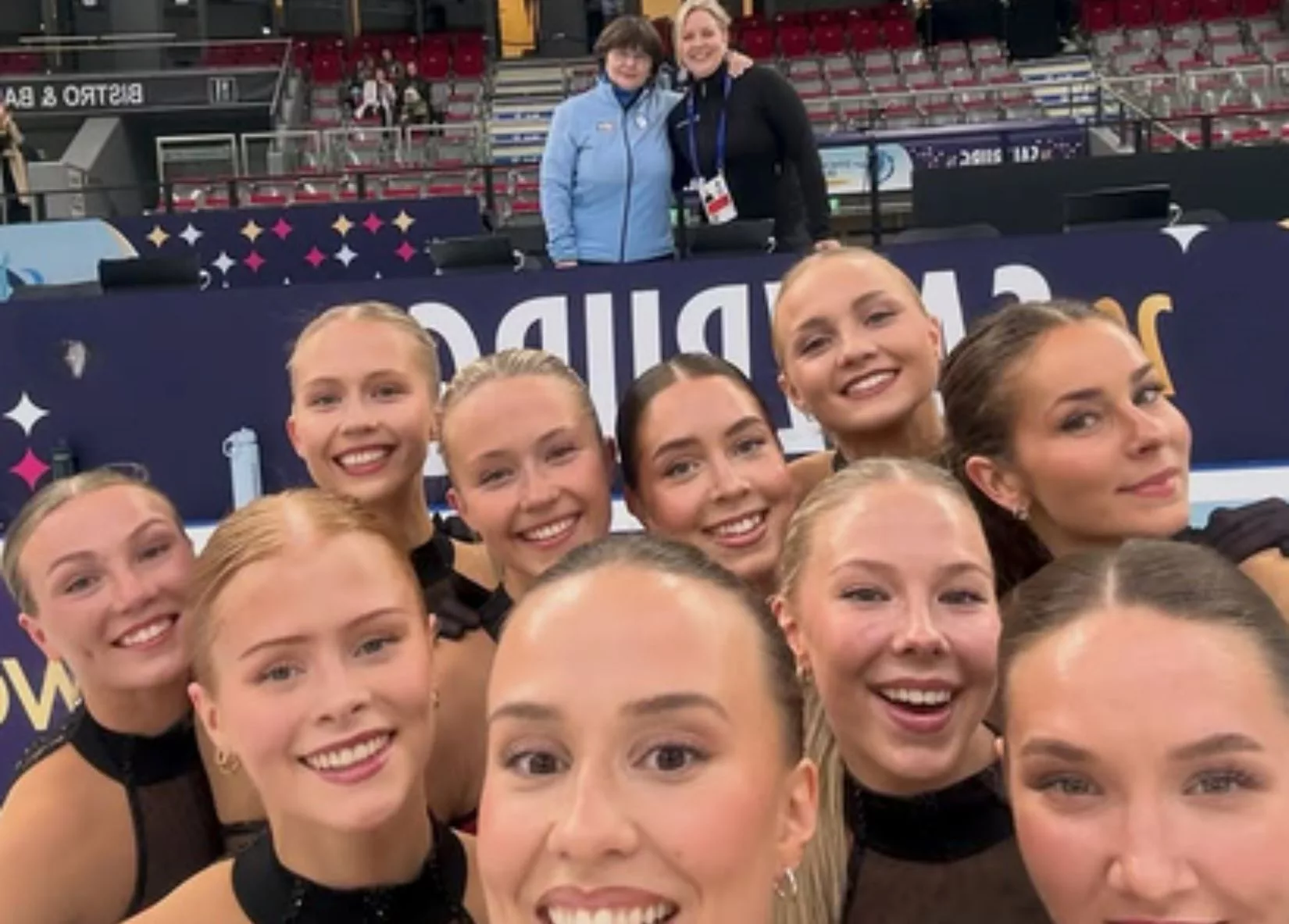
How did the ISU’s request for a nine-skater format come about?
Anu Oksanen (FIN) : "I got a phone call from working group member Susanna Rahkamo, who presented me with the concept and told me that the ISU wanted me to be the coach for the Finnish demo team."
When did you start working on this program, and about how many hours per week did it involve?
"We started working with the team at the beginning of January. There were a couple of times when we didn’t have practices for two weeks because of previous commitments of the skaters, or there were times when it was hard to find free ice time. Before leaving for Prague, we had practiced about 40 hours."
In your opinion, what are the main challenges or limitations of Synchro9?
"Challenges are definitely financial ones. With smaller teams, the costs are of course much higher. Do we find the skaters for this without losing the 12-16 synchro teams and countries now involved?
Finding ice time might be hard if countries are creating totally new teams.
Though we are creating something new and synchro can also be done with nine skaters, of course there are limitations on what kind of elements and formations teams can do."
What ISU rules or guidelines did you receive for this demonstration program? Were there any required elements, a set duration, or other specific instructions?
"I/we did get some guidelines, a draft of the rules, but didn’t have to follow them exactly. Also, giving feedback to the working group throughout the process helped them work on the rules. Some things that they wanted in general for Synchro9 to look like were used as a guideline for everything. We did have to go through the working group and for them to accept the theme, music, etc. The program was to be 3:00–3:30 long. While having some kind of “rules”, they wanted to give us the freedom to be creative."
How does working with nine skaters change the team’s usual dynamic?
"Since the team was smaller, it was also tighter, and as a coach I also got to know each individual better.
And also the contacts and interactions between the skaters were easier because of the smaller team. So the team was very tight."
What opportunities do you think this format could bring to the development of synchronized skating?
"We definitely hope that this is the path to the Olympics.
Hopefully this will draw a new audience to watch our sport. And with a smaller team, our sport will fit in a TV screen better, if it is shot right…
Those countries who struggle with the number of skaters, maybe this way they can build teams and continue competing also internationally."
Keeping the identity of synchronized skating
What did you have to adapt or leave out because of this format?
"Of course, those elements/formations that require more skaters had to be left out. Also, tighter formations made the team look small, so we had to test to see how they fill and cover the ice and look like there is still a team doing synchro on the ice. So, testing the placements of the skaters and different elements before building the program. No whip, for example…"
There has been a lot of criticism around this new format. What is your view after having experienced it firsthand?
"I was one of them who always said that we shouldn’t sell our sport just to get us to the Olympics. But now knowing that the dream is close with this new format, and for the first time I feel we have the support of the ISU, we all should support this. My main concern, and also the thing I kept in mind while choreographing the program, was that the skaters are synchro skaters, they look like synchro skaters and they do things that synchro skaters know how to do. No individual/single skating elements, though those can and will be part of the programs. Not compulsory, but possible.
I’m sure there was criticism, like in all skating always, and synchro people are a tough crowd… But we got much positive feedback, especially from top synchro coaches. They were very surprised to see what was possible, and those who were skeptical about this said that they were positively surprised and pleased to see what we had done."
What advice would you give to coaches or teams who might want to try this format in the future?
"Be brave to try something new and do it your way. We saw three very different programs in Salzburg, so that is the variety of things that can be done and from there develop this category further. But please do keep it as synchro, not turn it into group skating. The Team Event already exists, and we don’t want those skaters to replace our synchro skaters. Don’t want them to steal our skaters’ dream."
What is next for your Synchro9 team? Will you continue training in the coming weeks or months? And might we see the team again next season?
"This was a project for all of us involved. We’ll always be the original Finland Synchro9 and are proud of it. This was an amazing experience and memorable journey, and we got wonderful memories from it. Don’t know if some individuals will audition for the Finnish National Team. That is the way Finland is now proceeding: collecting the National Teams for both senior and junior. This was, for these skaters, a comeback to skating at the highest level, but most of them I think will return back to their normal life, being a full-time student or going back to work. For myself, it was just these few months I was involved. With these new responsibilities I have, I didn’t apply for the coaching positions for the National Teams."